Winter Adapted Species Assemblages
Abiotic environmental conditions and interspecific interactions function concurrently to define community assemblages. We broadly investigate the demographics, community assemblies and plastic responses (behavioral and phenotypic) of winter-adapted species in the Upper Great Lakes region to changes in climate. Many species possess behavioral, morphological, and physiological adaptations that allow them to persist in winter environments. Historically snowshoe hare (Lepus americanus), ruffed grouse (Bonasa umbellus) and porcupine (Erethizon dorsatum) all coexisted in the Tension Zone of Wisconsin at the southern edge of their range distributions, exhibited cyclic abundance and shared common predators, particularly fisher (Pekania pennanti). Observed demographic patterns of these prey populations may be driven by differential predation risk and antipredator strategies. We are interested in deepening our mechanistic understanding of these relationships, particularly as populations become increasingly challenged by changing winter climate.
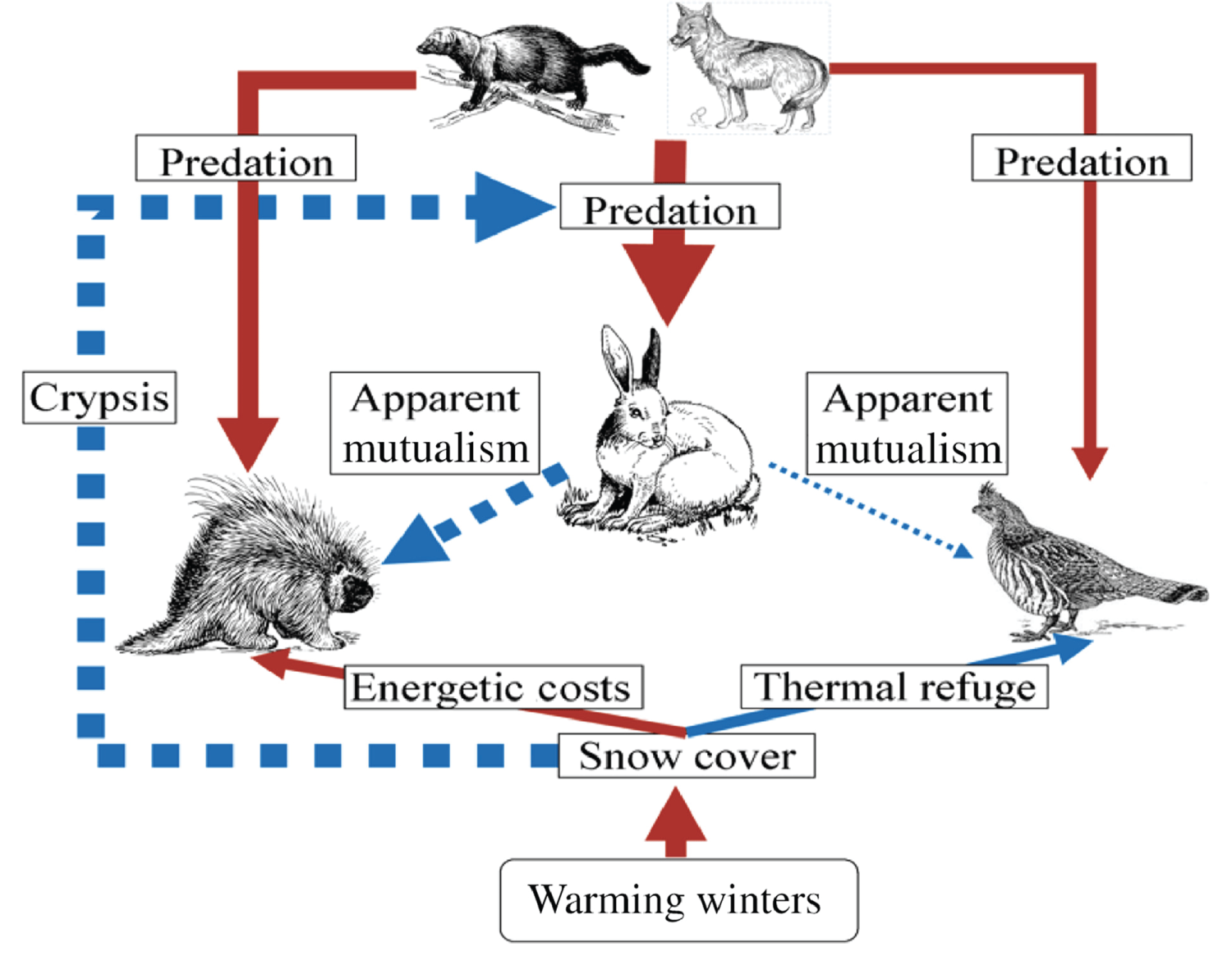
Modern climate change has created and will continue to create novel selective pressures and environmental conditions for species during winter. For instance, changes in the spatiotemporal distribution of snow cover will directly challenge organisms that rely on snow for camouflage, concealment, and thermal cover. Our research group is interested in understanding how plasticity in behavioral and morphological traits of winter-adapted species mediate the effects of changing winter climate on survival and patterns of species distributions.
Project Members: Shotaro Shiratsuru, Pairsa Belamaric
This research is highly collaborative. We receive funding from and partner with the following organizations: The National Park Service, Red Cliff Band of Lake Superior Chippewa, Great Lakes Indian Fish and Wildlife Commission, The United States Forest Service, Wisconsin Department of Natural Resources.