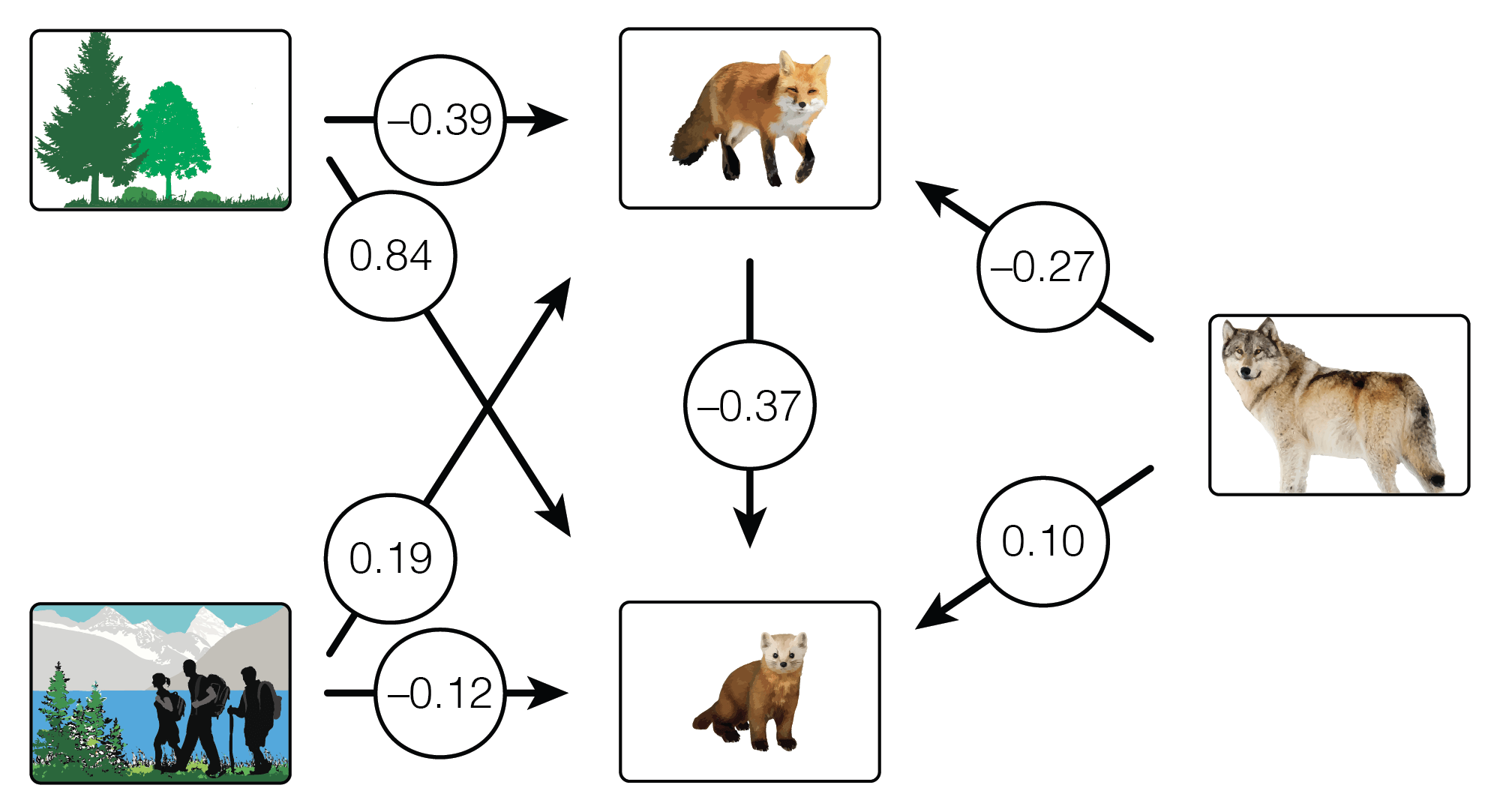
The consequences of predation and interspecific killing are a fundamental organizing principle of ecological communities, stipulating the importance of top carnivores as community- and ecosystem-level regulators. Large terrestrial carnivores increase trophic complexity and can buffer against, or even ameliorate, invasive species propagation, disease prevalence, and the effects of climate change – with important implications for biodiversity and human health. It is no surprise, then, that large terrestrial carnivores are one of the most extensively reintroduced taxonomic groups worldwide and carnivore restoration has become a global conservation priority. However, to effectively navigate the natural and managed repatriations of large carnivores, researchers and managers need a more comprehensive community-level framework that supplants contemporary single-species approaches.
Our research aims to deepen our understanding of the dynamic mechanisms underlying community structure while expanding the observed patterns of community composition and persistence following the repatriation of large carnivores. We do this by following a guild–to–community approach – emphasizing the interactions within trophic guilds that influence the broader community structure.
Within the carnivore guild, we aim to test the hypothesis that apex carnivores stabilize carnivore communities via a seasonally dynamic interplay of suppression and facilitation. Predicting that (i) in the absence of apex carnivores, meso–carnivores strongly, and negatively, influence small carnivores, (ii) apex carnivores negatively influence meso–carnivores, thereby creating niche space for small carnivores, and (iii) suppression and facilitation occur in a gradient, influenced by the seasonal dynamics of resource availability. To test this hypothesis, we are studying the effects of a recently reintroduced apex carnivore (the wolf [Canis lupus]) to a simple carnivore community featuring one meso– (the red fox [Vulpes vulpes]) and one small carnivore (the American marten [Martes americana]). Our work will reveal how suppression and facilitation structure carnivore communities across resource gradients, disentangle the mechanisms underlying meso– and small carnivore space use in pristine landscapes, and construct testable and predictive models of meso– and small carnivore space use following the repatriation of apex carnivores.
Project Members: Mauriel Rodriguez Curras,Shotaro Shiratsuru, Rebecca Chandross